Showing posts with label Movies. Show all posts

Tuesday, February 03, 2015

Predestination : What came first – the chicken or the egg?


My one-liner: What the f***?

The Spierig brothers (if like me you don’t recognize them yet, then after this movie you will) are German born Australian film makers. Their second feature with Ethan Hawke is a mind-bender of sorts that not only poses questions about time travel but also about the whole concept of being, at any one point of time, one entity and nothing else. Continuity is shown as a spun loop in a clever and satisfyingly open ended manner with relatively new entrant Sarah Snook playing a tough role with ease thus making Hawkes’ role seem almost like a foil. Watching it in the cinema would mean there is a strong possibility of returning to watch it again, however if one were watching it in the comfort of home, rewinding a few scenes is going to be inevitable.

Ethan Hawke is not unknown for his adventurous choice of movies, be it the horror thriller ‘Sinister’ or the Spierig brothers’ previous venture ‘Daybreakers’, the two time Academy Award nominee brings a grounded rootedness that make it seem like to have cast anyone else in the role would have been a folly. In choosing to star in the feature version of ‘All you zombies’ by Robert.A.Heinlein, Hawke once again shows his keen sense of picking out winners.  More of a revelation is aussie newcomer Sarah Snook who stars alongside Hawke and by the end of the movie corrects the notion to Hawke starring alongside her. Her innate sense of confidence and mature acting serves to only highlight her natural resemblance to Jodie Foster(does not take away anything from Sarah Snook) and her performance sort of lingers even after you finish watching her last shot in the movie.

The story loops around different decades but the brothers Spierig establish the ground rules very effectively within the first 25 minutes or so. And having those rules established makes viewing the movie and understanding the basic storyline that much easier for attentive viewers. The attention to detail is impressive, reflecting different eras like the 60’s, 70’s, 80’s etc in an easy and believable way without overcomplicating things. One thing that sort of didn’t completely make sense was the title itself, yes the word is bandied about a few times but never really explained in detail. However this could be a case of me being a little dimwitted and maybe the next couple of viewings (believe me, it will happen with you as well) will straighten things out. The make-up and special effects are beautifully understated and work very well in combination with the tone of the entire movie. Be it a 70’s era bar or a retro-futuristic training center from the 60’s the production design is excellent.

A lot can be said about the story but ‘Predestination’ is one of those movies where viewing it is an absolute pleasure as is figuring out the plot line. The trailer gives a simple picture of a temporal policing organization that prevents crimes(a la Philip K Dick stories). An agent is sent back to prevent the devastating attacks of the ‘Fizzle Bomber’. In his journey back in time he meets a man who names himself ‘The Unmarried Mother’ and says he can relate to the agent the best story he’s ever heard. A question posed to us again and perhaps again is that when confronted by the man who ruined one’s life what would one do when there is a guarantee of getting away with anything. Would death be such an easy thing to deal out or inflict? Time paradoxes are wonderfully interesting subjects that have been overdone in movies. But from time to time there comes along a movie that not only piques and sustains interest but prompts us to watch the movie a couple of more times for the sheer enjoyment of figuring out a puzzle. Full marks to the Spierig brothers, Michael and Peter, the latter of whom has also handled the background music superbly.


Three and a half stars

Tuesday, December 23, 2014

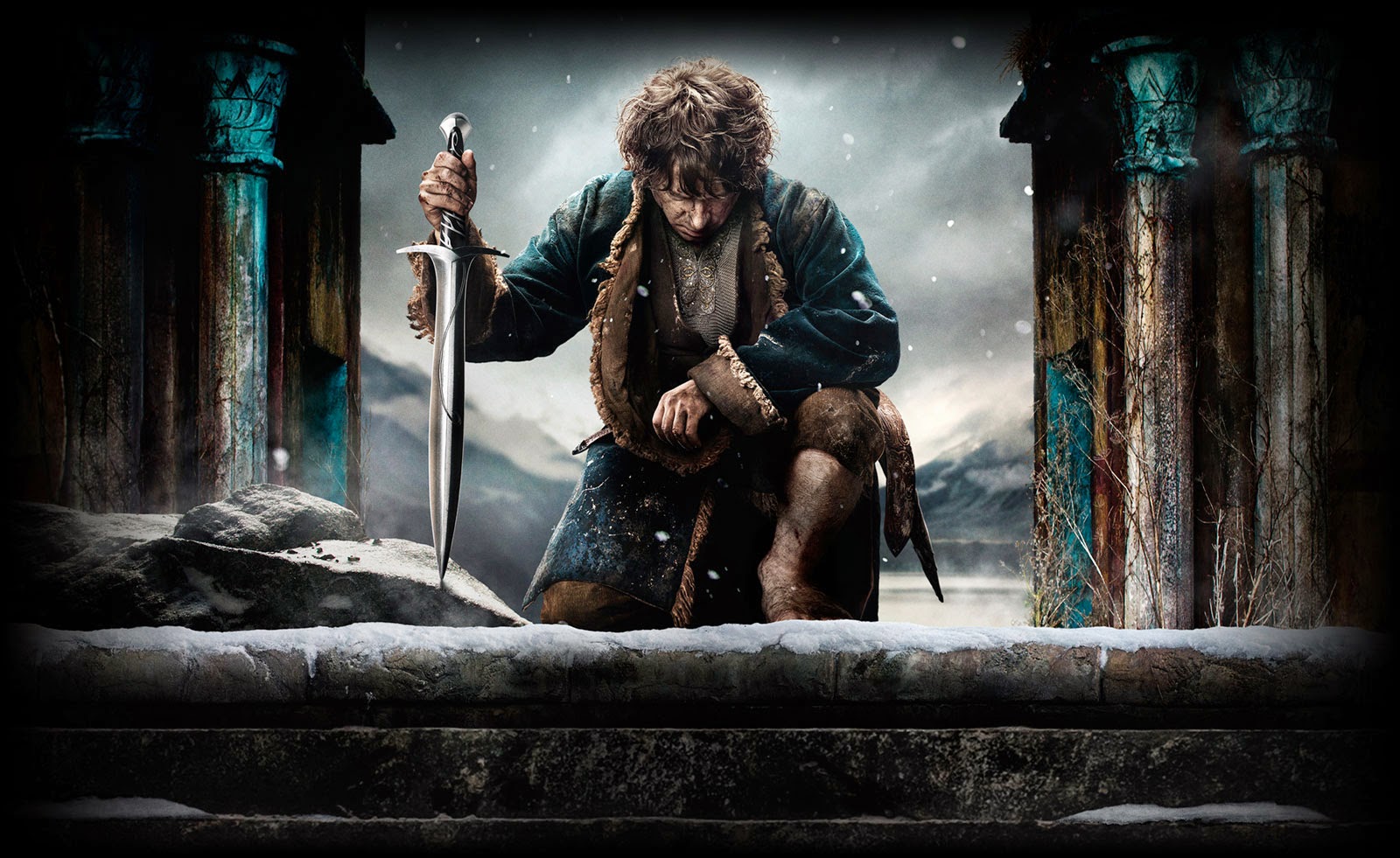
The Hobbit : The Battle of Five Armies – There and Back Again, emotionally so


My one-liner: Unfinished businesses, my precious, unfortunately!

Ananth's review
Some of us have followed Bilbo’s journey with the dwarves with great expectations, expectations that were forged upon and justified by the excellent Lord of the Rings trilogy. Sometimes the expectations were met, sometimes they were exceeded but never as a unit does ‘The Hobbit’ trilogy prove itself to be as well made as its sequel trilogy. Peter Jackson is a director of high capabilities and his screenplay for the Lord of the Rings written in partnership with Fran Walsh and Phillipa Boyens was a textbook example of how to adapt a fantasy with a moral that branched randomly into different story loops. The same trio with the addition of input from Guillermo Del Toro initially wanted two movies to be made out of a relatively small tome. A lot of us felt this was acceptable given the idea was to add bits in from the appendices which have a rich collection of lore. However when it was announced that three movies were going to be made in the place of two, studio greed not much different from dragon greed was suspected and now has been proven true. In saying all that, I am not taking away credit where credits due. ‘The Hobbit : The Battle of the Five Armies’ is the best of the hobbit trilogy but that, sadly, is not saying much. While it has been stripped down to bare action in its 144 minutes, there are bits of unnecessary drama thrown in as well with a single redeeming story loop.

Just as the ‘The Return of the King’ completed the quest of the fellowship, Bilbo’s journey with the dwarves is brought to completion with ‘The Battle of the Five Armies’. It wouldn’t be wrong to call this a war movie given that almost 45 minutes out of its 144 minute running time is spent on visuals of war. While from a technical standpoint the war scenes are very well made, from a personality standpoint some of Peter Jackson’s usual grit has been polished away. From the start of the trilogy, I’ve found that CGI orcs somehow cannot bring back the visual acuity that the Uruk Hai’s hot breath fogging in the cold air from the rain around Helms Deep did. It is indeed funny that, without having intended to, one of the characters in the movie yells out ‘Oh, come on!’ when the next flurry of CGI creatures is unleashed onto him. Elves are made out to be these magically agile creatures evidence Legolas’ fluid reverse swing onto horse back in ‘The Two Towers’ however the only thing missing during some of his visuals in this movie is an arcade games background. What shines through though is the strength of the CGI work in showing us Erebor, the ruins of Dale, the wrecking of Lake Town, the forbidding Gundabad and Sauron’s current stronghold Dol Guldur. Images that will stay with us when we re-read the books and for that we have John Howe and Alan Lee’s  vision of Middle Earth and WETA workshops implementation of them to thank.

The story of the dwarves and their quest forms the core of the book with Bilbo’s journey intertwined with them to provide the reader a pair of eyes to the spectacle. The moral of the book and the dwarves journey has been so blown up as only a trilogy worth 745 million dollars with the potential to reap a 3 billion dollar revenue can. ‘The Battle of the Five Armies’ finds a brooding Thorin who has succumbed to his lust for gold and treasure. Richard Armitage who was brilliant in the Desolation of Smaug pulls off the almost evil Thorin to a T, rising to claim his heroic right when all else has failed and in effect he has escaped his ‘illness’ however not before causing massive loss of life. Among the rest of the dwarves playing their requisite roles Balin remains the voice of reason. Billy Connolly is wasted as Dain Ironfoot, his make up makes it hard to even recognize him under the prosthetic layers. The unnecessary romance between Kili and Tauriel the elf is another deviation that takes away from the core of the movie and bores us en masse every time Tauriel spouts a dreamy dialogue exalting the power of love. Her king Thranduil maintains his agenda and delivers some really soppy dialogue as well in a couple of scenes involving Tauriel. Somehow it makes us think, without any prejudice of course, that the female half of the screenplay writers came up with these romances and triangles and as a lover of Tolkiens mythologies I do not see how it contributes to the story arc even a little bit.

Benedit Cumberbatch as Smaug wreaks his avenging havoc on lake town before the title comes up and is in turn dealt with by some inventive bow-work from Luke Evans playing Bard the Bowman. Luke Evans plays his role with the required maturity and restraint and does not give in to bombast. While some may think children repeatedly screaming for their father with anxiety written upon their faces is an emotional frame, the sound of ‘Da! Da! Da!’ made me want to somehow correct them as quickly and viciously as I could. Lake town, Bard, the Master(Stephen Fry) and his wormtongue equivalent Alfrid(Ryan Gage) actually provide for entertainment. Apart from some fan pleasing cameos from Cate Blanchett(Galadriel), Hugo Weaving(Elrond) and Christopher Lee(Saruman) when they come to the aid of the caged Gandalf(Ian McKellen) there isn’t too much that they are need for. Tragic is the omission of more screen time for Beorn which would have been fulfilling but I suspect the extended edition might have more things to celebrate. There isn’t too much more to be pleased about in the movie bar one more story arc.

Martin Freeman as Bilbo Baggins, the hobbit around whom the studio-coffer-pleaser has been written provides the single ray of sunshine in the entire movie apart from Richard Armitage’s brooding take on Thorin. Martin Freeman is the ultimate Bilbo, loyal to a fault even when he needs to betray to prove his loyalty, he brings forth the true and warm nature of Hobbits that Tolkien would have wanted us to experience. His chemistry with Gandalf and his faith in both Bard and Thorin are brought to life by his ingenious and whimsical portrayal of Bilbo. He does not care much for riches, war or for the vagaries of the wide world. In the book all he wants is a full pipe, a cozy armchair and a fireplace to stretch his hairy feet to and while the burglar aspect of his characterization is built up slightly here his is the performance that stands out most. Having been dragged out of his comfortable little hole under and over mountains to face a dragon and to end up being part of a war, Bilbo comes up trumps when the situation demands it ensuring that the faith of his friend and wizard Gandalf was not misplaced.

It is with sadness that we anticipated the ending of the Hobbit trilogy. Being the Middle-Earth-on-film fanatics that we are we badgered the PVR cinemas staff a lot in the days preceding the movies release given the tickets were not available for booking. At the end of the movie it would be unfair to say we were not slightly underwhelmed and while sitting through the end titles marking the end of our journey through middle earth on the big screen it wasn’t a few times that we reminded ourselves that the extended edition might fix some of the things that we found wanting. Peter Jackson’s work or labour of love as he calls it has been immense and he has dedicated a large chunk of his life to making these movies. While they will always be known as his swansong, there is no taking away from the fact that ‘The Hobbit’ trilogy could have been handled way better and maybe with a little less heavy handedness. Pandering to the fans would be language that is too strong to be used with someone of Peter’s acumen but in catering to them he has also done them a disservice in not providing with Bilbos journey what might have been a more triumphant return to Middle Earth. However while bidding farewell we cannot forget the immense pleasure derived from watching talented people come forth into our reckoning – Martin Freeman, Richard Armitage, Evangeline Lilly, Lee Pace, Mikael Persbrandt and the return of crowd favourites in Legolas, Gandalf, Galadriel, Elrond and Saruman(who incidentally kicks more ass than any 92 year old could or should). The moral of ‘The Hobbit’ perhaps was not as clear as it should have been to Newline, MGM, Wingnut and Warner Brothers – Greed is folly.


Three Stars 

Wednesday, November 19, 2014

Nightcrawler - If it bleeds it leads!

Looking up Nightcrawler on wikipedia so I'd have the cast and crew mentions accurate for this review revealed that they are categorising it a 'crime thriller'. As such I would move it over into the territory of 'pyschological thriller' just as easily. Jake Gyllenhaal's character, Lou Bloom, can only be described as a sociopath climbing the rungs and stumbling on an elevator to ascending stages of depravity.  A couple of movies came to mind, one when looking at Lou's final strut and another on recalling the events of the movie for this review. The latter is 'Taxi Driver' which also highlights the mental ascent of a loner to increasing stages of anti-social characterization. Nightcrawler deals with the always on camera of a news-gatherer in the city of angels, gathering up sins on video and declaring its motto via the dialogue of Bill Paxton - 'If it bleeds, it leads'.

Working from a script he wrote, Director Dan Gilroy(brother of Tony Gilroy) takes us through the darkness of LA and Lou's mind systematically. The story does not let us give up and zone out at any point with Dan reminding us that none of the thrills or the evenly spaced laughs, black comedy as it may be, comes free or cheap. It almost feels like the view we get of Lou is one of the inner reaches of his  mind, the part where there is a small stage whisper that is always prompting him to claw rather than reach. Robert Elswit handles the camera for Nightcrawler giving us a sort of a night-mode modern noir view of the city, never completely dark but shady enough for discomfort. There are parts when the background music by James Newton Howard  almost approaches a sort of retro pop level of cheeriness, beautifully contrasting with the images on screen.

Jake Gyllenhaal needs no introduction as an actor capable of carrying off the darkness of a character in a disturbingly nonchalant way but as the titular Nightcrawler his dialogues delivered in a casual almost cheerful monotone are sometimes plain scary. His evolution from someone who steals and deals scrap metal to the owner/director of 'Video News Corporation' leads us on a dark odyssey with Lou at the helm. His home is shown to be a single room with a bed facing a stark lcd screen that runs the news. Lou stares, thinks, plans and sometimes chuckles and the most passive of his actions disturbs. He is an avid learner, someone who is able to rattle off leadership and management principles and jargon(probably from the latest TedX) and is a skilled researcher as well. His mind does not stop there, beneath the pallor of his skin is a darkness that Jake Gyllenhaal plumbs with seemingly no effort but the depth of his skill is evident in the coldness that settles against his behavior in the minds of the viewers.

Jake is supported by a cast which is put together brilliantly well. Rene Russo as the newsdesk chief of one of the hundred pulp news channels of LA walks the extremely delicate line between victim and other dark shades with her usual ease. When pushed into a corner, should one decide the corner is home? Maybe but what if the corner always has been home? Characters that dip in and out make us question the depths of human behaviour as well. Riz Ahmed (of the superb adaptation of 'The Reluctant Fundamentalist') gets recruited to be Lous cohort in night time video gathering sessions. Seemingly flat, the characters layers are peeled as is Bill Paxton's, the latter playing a competing Nightcrawler who initially shuns Lou's approach but tries to recruit him later, a sequence that ends with my favourite bit of Gyllenhaal in the movie.

The movie also showcases the nature of news channels that sometimes deliver and deliver without questioning if its through a curtain of tears. Its not only Lou who cannot take no for an answer and takes 'by hook or crook' to a new level of videography but it is the entire ecosystem in which he thrives. The extreme levels of motivation that come forth from someone who is introduced to us as a normal and capable everyday guy only serve to question our own judgement of people as we go along. Lou does not change but our perspective of him is guided through so expertly that by the conclusion there is an illusion of something having crawled into the night space of our minds. As mentioned in the first paragraph, another movie came to mind when Lou struts in front of a police station - Kevin Spacey's self imposed limp disappearing at the end of 'The Usual Suspects' and inexorably the thread that exists between great movies gains another fibre.

Four stars and two thirds.

Friday, August 01, 2014

The plot thickens, as they say. Why, by the way? Is it a soup metaphor?

Guest Post : Movie Review : The Grand Budapest Hotel

I haven’t watched all of Wes Andersons cinematic creations. But having watched ‘The Life Aquatic with Steve Zissou’, ‘The Darjeeling Limited’ and ‘Moonrise Kingdom’,the trailer for ‘The Grand Budapest Hotel’ kindled in me curiosity more than anticipation in watching it. Anticipation was always a given after ‘The Darjeeling Limited’ but the vision of Ralph Fiennes and the smorgasbord of A-list actors invoked in me a curiosity hitherto unfounded. The movie, in all certainty was not going to disappoint, threw bountiful surprises that made one smile, choke, burst out in guffaws but also lean back and contemplate. A movie that is personified in one of M.Gustave’s(more about him shortly) prolific utterances while explaining how humanity remains in humble(read stupendous) offerings of his esteemed establishment – a generous sentence of praise ending with ‘F**k it’.

It would be best to use a simile coined for a different purpose in describing the movie – while appearing to be an oil landscape from the 1920’s it actually presents itself as a secret wrapped in a mystery in the jacket pocket of an enigma. Anderson shares story credits for it with Hugo Guiness who both share credit with the author Stefan Zweig whose writings inspired the story. The opening shot presents a young lady gazing at a seated statue of the ‘Author’ (Tom Wilkinson) whose tome ‘The Grand Budapest Hotel’ she is reading. The book delves into a first person narrative of Tom Wilkinson as a young ‘Author’ (Jude Law) who recounts a meeting with M.Moustafa(F Murray Abraham), the proprietor of the titular hotel. Said hotel is of legendary quality but like the statue of Ozymandias, crumbling to current ruin. Jude Laws character having expressed curiosity as to why the owner of such opulence opts to spend his time in a cubby hole within upon his yearly visit gets invited to dinner with M.Moustafa. The dinner is designed to be the succulent main course fed morsel by elaborately crafted morsel to satisfy both the Authors and our curiosity pangs.

Clipped and short shots are used to introduce us to the hotels days of splendor(do not miss the cable car, an indelible stamp of the film) and to Zero(Tony Revolori), a bell boy under the wing and tutelage of the glorious M.Gustave(Ralph Fiennes). While teaching Zero the intricacies of being a bell boy i.e. the art of providing the guests at The Grand Budapest everything they may need or want when they need or want it without even them knowing they need or want it, M.Gustave shows himself to be the perpetual didact enlightening us throughout the narrative, even preaching perhaps. To characterize him as a refined but horny gigolo would not be mincing words. Monsieur being the pinnacle of said character while remaining supremely classy to the point of being a magnet to ladies of the rich and elderly variety, his preferred clientele. Supporting characters appear in the form of Dimitri(Adrien Brody in a deliciously evil role as the son of one of Monsieurs clients), Jopling(a very scary Willem Dafoe, positively vampirish), Deputy Kovacs(no matter what the period, dialogue or makeup Jeff Goldblum will be – pause for effect and dainty shrug – Jeff Goldblum), Inspector Henckles(Ed Norton, subtlety itself) and to spare the pleasurable tedium of putting character name to actor – Aaron Sorkin, Mathieu Amalric, Lea Seydoux, Saoirse Ronan, Bill Murray and lest we forget, Owen Wilson.

The Grand Budapest Hotel remains translucently etched in the background of our vision while a set of almost bioscope-quality events run through in the foreground. Ralph Fiennes in perhaps the performance of his career so far shifts from being concierge generale to gigolo to favoured recipient to a ‘straight’ fellow(a remark he decries sarcastically as never having been accused of) to a friend in need to a benefactor.  Watching him play these roles while maintaining his demeanor of the refined but vulgar M.Gustave, full of finesse and euphemism, double entendre and general swearing is a cinematic treat that should not be missed.

It would be doing the film an injustice to delve into its details or to attempt to summarize it. What can be done is accord to The Grand Budapest Hotel every accolade it deserves. While being everything it already is, the movie(and by implication Anderson) even manages to pull the subtle veil of war into its crowded but never murky tapestry. Frantic yet still, refined yet vulgar, subtle yet bombastic, The Grand Budapest Hotel thrills every cinematic nerve we would expect to be tweaked while promising to come back and tickle them just as M.Gustave would have.

5/5 

Friday, July 25, 2014

War has begun.

Guest post : Movie Review - Dawn of the planet of the apes

‘Rise of the Planet of the Apes’ introduced us to Caesar, his struggles with his identity after being passed on residual genetic effects resulting in him being super-intelligent with capabilities sometimes surpassing human. The ethical conundrums that were posed during ‘Rise’ brought us to a conclusion where what was dubbed as ‘Simian flu’  had taken its toll on humans but left the planets apes or at least the group of them in America with enough intelligence to develop under Caesars leadership and training.

Dawn cuts over to ten years after the virus has spread throughout the world(from the title snapshots) and sets the tone straightaway with a confrontation which is almost a prelude to Caesar observing later ‘I did not know we were so much like them’. The apes’ settlement needs to be passed through for the humans to be able to bring power to SF where a small group of survivors led by Dreyfuss(Gary Oldman) still exists. When Caesar agrees to an appeal from Malcolm(Jason Clarke) who represents the reasonable side of the humans and assures Caesar that the apes will come to no harm, unrest and emotions hitherto unexpressed in the ape community make an appearance. Conflict and chaos are not only shown as byproducts of civilization but their base roots are traced in spectacular fashion. Justifications are put forth by the apes and the humans, both reasonable and unreasonable depending on the perspective.

The movie might as well be compared to some of the best sequels in movie history(for example ‘The Godfather II), the poignancy being elevated to an all new level not only by the director Matt Reeves but also by the nuanced and brilliant motion capture performance of Andy Serkis who doesn’t just stop at breathing life into Caesar but gives him a persona that is almost as memorable as characters like Vito Corleone. Caesar and Koba(Toby Kebbell) don’t just have the crouched walk of apes but have expressions that correspond so much to our nearest cousins in the animal kingdom that it would be a shame if WETA does not win the special effects statuette from a fair few awards again.

It would also be improper to not mention the casting coup(cannot call it anything else) that has been achieved in casting Gary Oldman as Dreyfuss, defacto leader of the surviving humans(to not spoil the movie I cannot mention his equivalent in the ape group), Jason Clarke as Malcolm, Keri Russell as Malcolms wife Ellie and more who pull off performances that hold their own against the apes. Judy Greer plays Caesars mate Cornelia who does not have too much of a role in this movie with calm grace.

The cinematography(Michael Seresin) keeps our eyes glued to the post converted 3D scenes be it in the jungle or in almost post-apocalyptic San Franciscan city borders. A scene with a tank  is reminiscent of well made war movies putting the audience in thedrivers seat and reminding us of the current ugly machinations going on in Gaza and elsewhere. Michael Giacchinos music reminds us of much more poignant fare such as Kurosawas epics in its simplicity and puts us inthe forefront of action whenever the scene shifts.

Dawn’ shows us how an intelligent science fiction movie can be made, building on Rupert Wyatts ‘Rise’ and never slowing down. In characterizing Caesar as far possible from his Roman nomenclature as possible, in fact as a Gandhi albeit one who does not say no to violence where it is deserved, Matt Reeves and Andy Serkis serve a classic combination that does not so much as deliver a punch but makes us recover and take notice. The wanton violence as delivered by Koba is not so much inevitable as representative of everything that goes wrong when a single person incapable of sensible leadership is faced with a shot at power. The climax builds to a crescendo without being shoved down the throat of the viewers and when Caesar pronounces the words that denounce his opposer, the subtlety becomes ironically obvious.

A beautiful mixture of intelligence and cinematic skill, Dawn of the Planet of the Apes deserves sure mention in the annals of good science fiction blockbusters that are not senseless in their implementation.
4/5