Showing posts with label Benedict Cumberbatch. Show all posts

Tuesday, February 03, 2015

The Imitation Game review – Are you paying attention?


'The reason people like violence' – explains Turing in ‘The Imitation Game’ – 'is because it feels good and humans find it deeply satisfying. When the satisfaction is removed, violence and cruelty tend to become hollow'. Alan Turing, played by Benedict Cumberbatch, is shown trying to break the Enigma code, used by the Nazis during the Second World War to control and communicate with their troops across Europe, while facing the usual resentment that is faced by geniuses who more often than not end up being labelled odd. After an hour and a half of entertainment the movie leaves us  sad (for the second time in January) and critical of humanity and its unrelenting persecution of the majority perception of normality.


‘The Imitation Game’ is a movie that is not to be missed, if the obvious current form of Benedict Cumberbatch isn’t reason enough then there are quite a few reasons that assert said sentiment – Morten Tydlums direction, Graham Moore’s screenplay adapted from the book ‘Alan Turing – The Enigma’ and last but not least Alexandre Desplats haunting soundtrack. The single dialogue that I found annoying because of its repetition forms the core of the movie – Sometimes it is the people no one imagines anything of who do the things that no one imagines. As has been made obvious by the previews, the movie revolves around the small group of people, more specifically Alan Turing, who designed a code breaking machine as part of the British War effort and led to the ending of the Second World War. Without giving away any details the movie also deals with the delicate and deserved rights of homosexuals. Homosexuality as a behavioral pattern has been with us for ages and yet there are laws declaring it illegal(still) in parts of the world. One such (thankfully now obsolete) law cut short the life of Alan Turing, the man who pioneered digital computers  and ironically the winner of the Order of the British Empire for services rendered during the war. In showcasing the life of this unsung genius ‘The Imitation Game’ highlights the immensely ‘too little too late’ nature of the so called ‘Royal Pardon’ granted to Alan Turing by the Queen in 2013.

Benedict Cumberbatch is not new to playing iconic characters or dragons. As Sherlock, Khan Noonien Singh and as Smaug he gave us performances that brought joy to a viewer interested in the study of forceful personalities and their meticulous portrayal on screen. While it is excusable to initially be reminded of a more introverted Sherlock(if that is possible) when seeing Cumberbatch on screen as Turing, it is inexcusable if within the span of about 15 minutes, his nuanced and studied take cannot be appreciated. In the glassiness of his eyes, in the less flamboyant diction, in the dentures worn to take away the sharpness of his face and to influence his speech, Cumberbatch is at his best in conveying the genius behind his arrogant façade while still making the viewer sense his vulnerability and the melancholy within. The brilliant cast is augmented by Keira Knightleys intelligent portrayal of Joan Clarke, Turings partner during their work in Bletchley Park. Clarke is recruited by Turing after his elevation to head of the project and she works with him in breaking Enigma and more importantly in connecting him more with his project mates. The latter group has among them Matthew Goode playing the dashing Hugh Alexander and Allen Leech playing John Cairncross, all of them under the watchful beady eyes of the MI6 and its head Stewart Menzies played brilliantly by Mark Strong.

Turing is introduced to us as a calculatedly arrogant mathematical genius volunteering for work in Bletchley Park and reluctantly being allowed to join the group working on breaking Enigma by Commander Deniston(Charles Dance). What follows is history with a few dramatic overtones but largely a study of the nature of Alan Turing and his work. Given that his work and ideas have been kept secret for over 50 years and have been brought to the fore only recently the movie allows us to glance into the tense inner workings of the team that managed to solve what was regarded by the world as an unbreakable code. Morten Tydlum in his debut English feature makes sure the movie does not seem like a science lecture while including a decent amount of technical knowledge  for the enthusiasts (though I would have liked Keira Knightley to pronounce Euler the right way). The production values are excellent starting from the look and feel of Britain during the war, specifically during the Blitz down to the costumes of the cast and extras. Alexandre Desplat delivers yet another beautiful soundtrack with melodic flair conveying the tension underlying in the narrative while never missing the gravity of the situation.

In one of his best performances, Benedict Cumberbatch reduces us to tears in some of the sequences, the best of which he shares with Keira Knightley. As a genius mathematician who’s love has been shared ironically as a binary split between a man and a machine both of which have been transitory in his life, Cumberbatch conveys the loneliness that has been wrought upon him not only by himself but by society as a whole. As a subject of investigation by detectives who are brought to his doorstep after complaints of a break in, Turing’s dismissal of them only provokes them into searching for skeletons in his closet. He is seen remarking upon the toxic nature of cyanide which is now suspected as the means of his suicide at the young age of 41. The Turing test and Turing machines, both terms deserving of a google search and thorough read are but two of the massive advances in mathematical machines and science showcasing what could have been if only Turing were not the subject of societal castigation. In composing this review with automatic font setting and formatting and the easiness with which I am able to reach you, esteemed reader, we have both Turing’s immortal genius to thank.


Four Stars

Tuesday, December 23, 2014

The Hobbit : The Battle of Five Armies – There and Back Again, emotionally so


My one-liner: Unfinished businesses, my precious, unfortunately!

Ananth's review
Some of us have followed Bilbo’s journey with the dwarves with great expectations, expectations that were forged upon and justified by the excellent Lord of the Rings trilogy. Sometimes the expectations were met, sometimes they were exceeded but never as a unit does ‘The Hobbit’ trilogy prove itself to be as well made as its sequel trilogy. Peter Jackson is a director of high capabilities and his screenplay for the Lord of the Rings written in partnership with Fran Walsh and Phillipa Boyens was a textbook example of how to adapt a fantasy with a moral that branched randomly into different story loops. The same trio with the addition of input from Guillermo Del Toro initially wanted two movies to be made out of a relatively small tome. A lot of us felt this was acceptable given the idea was to add bits in from the appendices which have a rich collection of lore. However when it was announced that three movies were going to be made in the place of two, studio greed not much different from dragon greed was suspected and now has been proven true. In saying all that, I am not taking away credit where credits due. ‘The Hobbit : The Battle of the Five Armies’ is the best of the hobbit trilogy but that, sadly, is not saying much. While it has been stripped down to bare action in its 144 minutes, there are bits of unnecessary drama thrown in as well with a single redeeming story loop.

Just as the ‘The Return of the King’ completed the quest of the fellowship, Bilbo’s journey with the dwarves is brought to completion with ‘The Battle of the Five Armies’. It wouldn’t be wrong to call this a war movie given that almost 45 minutes out of its 144 minute running time is spent on visuals of war. While from a technical standpoint the war scenes are very well made, from a personality standpoint some of Peter Jackson’s usual grit has been polished away. From the start of the trilogy, I’ve found that CGI orcs somehow cannot bring back the visual acuity that the Uruk Hai’s hot breath fogging in the cold air from the rain around Helms Deep did. It is indeed funny that, without having intended to, one of the characters in the movie yells out ‘Oh, come on!’ when the next flurry of CGI creatures is unleashed onto him. Elves are made out to be these magically agile creatures evidence Legolas’ fluid reverse swing onto horse back in ‘The Two Towers’ however the only thing missing during some of his visuals in this movie is an arcade games background. What shines through though is the strength of the CGI work in showing us Erebor, the ruins of Dale, the wrecking of Lake Town, the forbidding Gundabad and Sauron’s current stronghold Dol Guldur. Images that will stay with us when we re-read the books and for that we have John Howe and Alan Lee’s  vision of Middle Earth and WETA workshops implementation of them to thank.

The story of the dwarves and their quest forms the core of the book with Bilbo’s journey intertwined with them to provide the reader a pair of eyes to the spectacle. The moral of the book and the dwarves journey has been so blown up as only a trilogy worth 745 million dollars with the potential to reap a 3 billion dollar revenue can. ‘The Battle of the Five Armies’ finds a brooding Thorin who has succumbed to his lust for gold and treasure. Richard Armitage who was brilliant in the Desolation of Smaug pulls off the almost evil Thorin to a T, rising to claim his heroic right when all else has failed and in effect he has escaped his ‘illness’ however not before causing massive loss of life. Among the rest of the dwarves playing their requisite roles Balin remains the voice of reason. Billy Connolly is wasted as Dain Ironfoot, his make up makes it hard to even recognize him under the prosthetic layers. The unnecessary romance between Kili and Tauriel the elf is another deviation that takes away from the core of the movie and bores us en masse every time Tauriel spouts a dreamy dialogue exalting the power of love. Her king Thranduil maintains his agenda and delivers some really soppy dialogue as well in a couple of scenes involving Tauriel. Somehow it makes us think, without any prejudice of course, that the female half of the screenplay writers came up with these romances and triangles and as a lover of Tolkiens mythologies I do not see how it contributes to the story arc even a little bit.

Benedit Cumberbatch as Smaug wreaks his avenging havoc on lake town before the title comes up and is in turn dealt with by some inventive bow-work from Luke Evans playing Bard the Bowman. Luke Evans plays his role with the required maturity and restraint and does not give in to bombast. While some may think children repeatedly screaming for their father with anxiety written upon their faces is an emotional frame, the sound of ‘Da! Da! Da!’ made me want to somehow correct them as quickly and viciously as I could. Lake town, Bard, the Master(Stephen Fry) and his wormtongue equivalent Alfrid(Ryan Gage) actually provide for entertainment. Apart from some fan pleasing cameos from Cate Blanchett(Galadriel), Hugo Weaving(Elrond) and Christopher Lee(Saruman) when they come to the aid of the caged Gandalf(Ian McKellen) there isn’t too much that they are need for. Tragic is the omission of more screen time for Beorn which would have been fulfilling but I suspect the extended edition might have more things to celebrate. There isn’t too much more to be pleased about in the movie bar one more story arc.

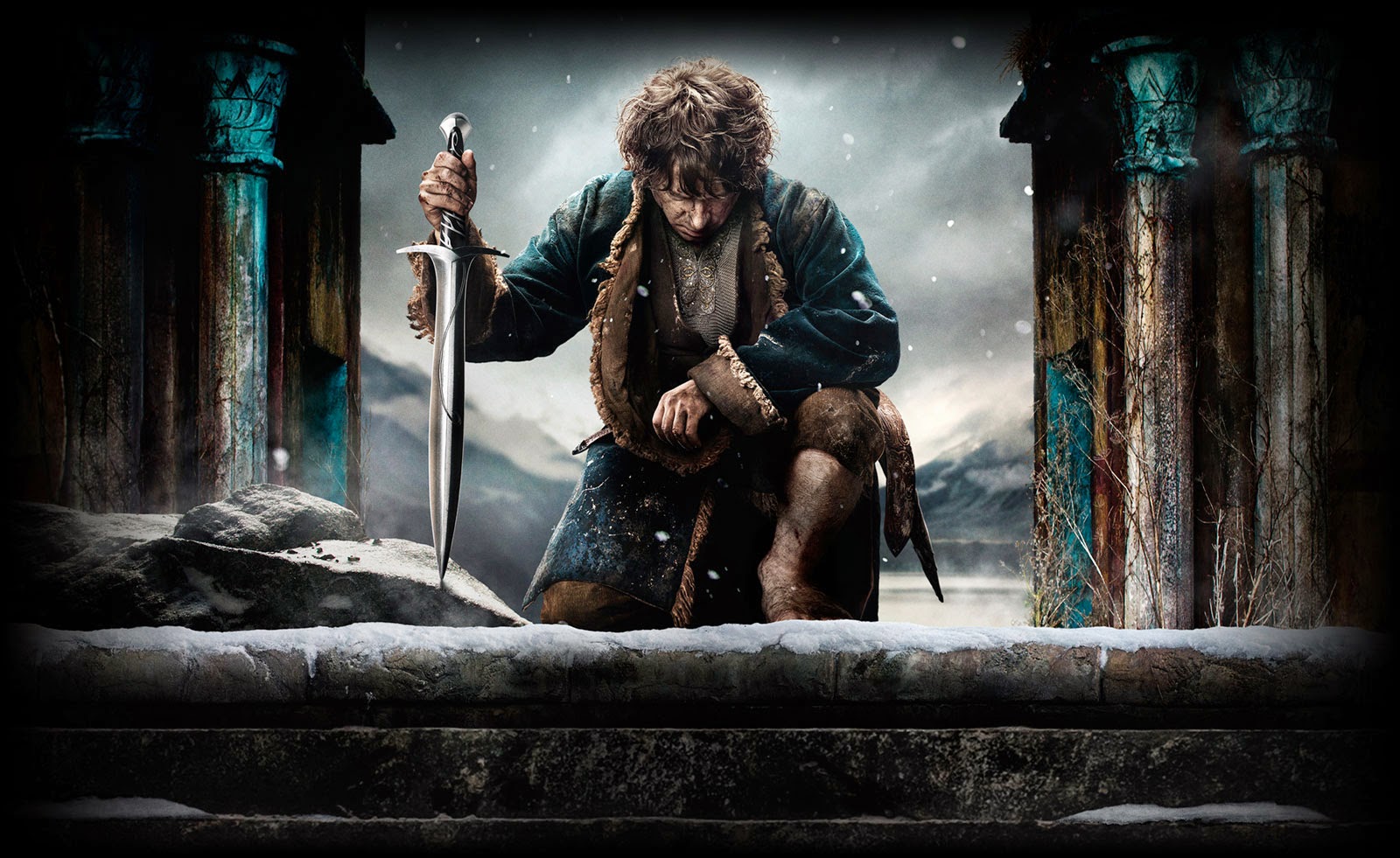
Martin Freeman as Bilbo Baggins, the hobbit around whom the studio-coffer-pleaser has been written provides the single ray of sunshine in the entire movie apart from Richard Armitage’s brooding take on Thorin. Martin Freeman is the ultimate Bilbo, loyal to a fault even when he needs to betray to prove his loyalty, he brings forth the true and warm nature of Hobbits that Tolkien would have wanted us to experience. His chemistry with Gandalf and his faith in both Bard and Thorin are brought to life by his ingenious and whimsical portrayal of Bilbo. He does not care much for riches, war or for the vagaries of the wide world. In the book all he wants is a full pipe, a cozy armchair and a fireplace to stretch his hairy feet to and while the burglar aspect of his characterization is built up slightly here his is the performance that stands out most. Having been dragged out of his comfortable little hole under and over mountains to face a dragon and to end up being part of a war, Bilbo comes up trumps when the situation demands it ensuring that the faith of his friend and wizard Gandalf was not misplaced.

It is with sadness that we anticipated the ending of the Hobbit trilogy. Being the Middle-Earth-on-film fanatics that we are we badgered the PVR cinemas staff a lot in the days preceding the movies release given the tickets were not available for booking. At the end of the movie it would be unfair to say we were not slightly underwhelmed and while sitting through the end titles marking the end of our journey through middle earth on the big screen it wasn’t a few times that we reminded ourselves that the extended edition might fix some of the things that we found wanting. Peter Jackson’s work or labour of love as he calls it has been immense and he has dedicated a large chunk of his life to making these movies. While they will always be known as his swansong, there is no taking away from the fact that ‘The Hobbit’ trilogy could have been handled way better and maybe with a little less heavy handedness. Pandering to the fans would be language that is too strong to be used with someone of Peter’s acumen but in catering to them he has also done them a disservice in not providing with Bilbos journey what might have been a more triumphant return to Middle Earth. However while bidding farewell we cannot forget the immense pleasure derived from watching talented people come forth into our reckoning – Martin Freeman, Richard Armitage, Evangeline Lilly, Lee Pace, Mikael Persbrandt and the return of crowd favourites in Legolas, Gandalf, Galadriel, Elrond and Saruman(who incidentally kicks more ass than any 92 year old could or should). The moral of ‘The Hobbit’ perhaps was not as clear as it should have been to Newline, MGM, Wingnut and Warner Brothers – Greed is folly.


Three Stars